Skip to content
Concrete Texture

THE
SUBCONTINENTAL
MONOLITH

The Subcontinental Monolith: Brutalism as Statecraft

// INTRODUCTION

The arrival and subsequent domination of Brutalism in post-independence India represents one of the most fascinating architectural paradoxes of the 20th century. While in Europe, Brutalism emerged as a gritty, utilitarian mechanism for replacing bombed-out slums and austere welfare-state rationing, in India, it was deployed as a wildly ambitious, technologically advanced vocabulary for immediate nation-building. Freshly liberated from British colonial rule, India, under the leadership of Prime Minister Jawaharlal Nehru, faced the impossible task of leapfrogging centuries of suppressed industrial development. Nehru despised the colonial 'Indo-Saracenic' style—with its patronizing pastiches of domes and arches—as a symbol of subjugation. He demanded an architecture that was rigorously modern, undeniably democratic, and completely divorced from the heavy, ornamented weight of the country's feudal past. Brutalism offered an immediate solution: a heroic, unyielding architectural language that projected immense institutional permanence and robust public sector authority. Furthermore, the inherent material reality of 'béton brut' (raw concrete) was exceptionally well-suited to the immediate Indian context. It demanded immense amounts of relatively cheap, manual labor for the elaborate timber formwork, yet required very little high-grade imported structural steel. However, Indian architects did not merely import the European aesthetic wholesale. They fundamentally radically adapted Corbusian and European Brutalist principles into an indigenous modernism. They wrestled with severe tropical constraints—punishing sun, torrential monsoons, and extreme heat—by deploying massive concrete brise-soleils (sun-breakers), deeply recessed shading mechanisms, and porous, naturally ventilated spatial corridors that transformed Brutalist monoliths into deeply climate-responsive sanctuaries.

STATECRAFT & MASTERWORKS

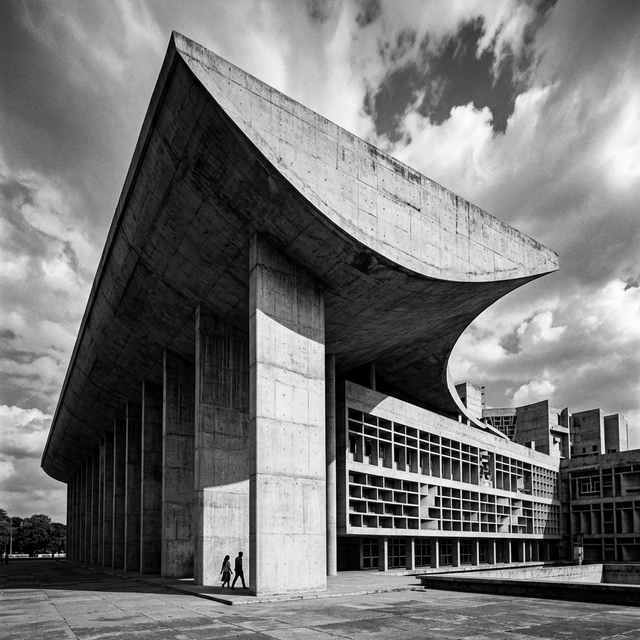
The sweeping, sculptural concrete parasol roof of the Palace of Assembly, Chandigarh
1951
Le Corbusier

Chandigarh Capitol Complex

Chandigarh, India

Le Corbusier's masterplan for the new capital city of Punjab, Chandigarh, stands as the absolute colossal zenith of Brutalist urban planning. Commissioned directly by Nehru to build a city 'unfettered by the traditions of the past,' Corbusier responded with an unprecedented exercise in monumental scale and pure geometric form. The Capitol Complex—comprising the Secretariat, the High Court, and the Palace of Assembly—is entirely composed of vast, aggressively exposed concrete volumes. The genius of Chandigarh lies in Corbusier's radical translation of his European Brutalist vocabulary to address the extreme Indian climate. Recognizing that glass curtain walls would create uninhabitable greenhouses under the punishing north Indian sun, he invented a monumental architectural shading device: the brise-soleil. The facades of the Secretariat and the High Court are entirely defined by massive, deeply recessed concrete grids that block direct sunlight while permitting cross-ventilation. At the Palace of Assembly, he capped the monumental legislative chamber with a colossal, upward-sweeping hyperbolic paraboloid concrete parasol roof—a sculptural tour de force that deflects monsoon rains while acting as a monumental aesthetic crown. The entirety of the complex relies heavily on board-marked concrete, visibly celebrating the intense manual labor of the thousands of Indian workers who cast the heroic structures. Chandigarh is not merely a collection of Brutalist buildings; it is an aggressively modern state apparatus rendered entirely in raw earth and cement.
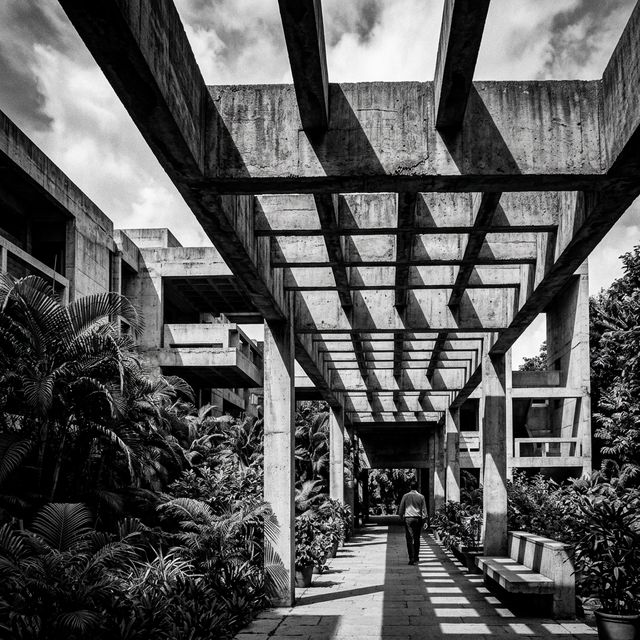
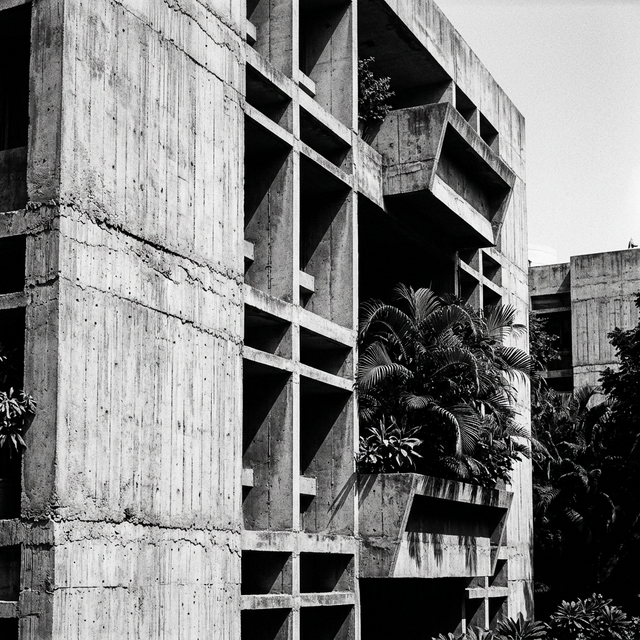
IIM Bangalore's deeply shaded stone and concrete corridors with rigorous geometric shadows
1973
Balkrishna Doshi

Indian Institute of Management (IIM) Bangalore

Bangalore, Karnataka, India

Balkrishna Doshi (a protégé of Le Corbusier) achieved a breathtaking masterpiece of 'porous Brutalism' at the Indian Institute of Management (IIM) in Bangalore. While Corbusier's Chandigarh was largely defined by monumental, isolated objects placed upon a vast plain, Doshi recognized that true Indian urbanism relies on dense, shaded, labyrinthine spatial configurations. He merged the heroic, unyielding palette of Brutalism—specifically utilizing massive expanses of exposed, board-marked concrete intermixed with hand-chipped local granite—with the spatial logic of traditional Indian temple complexes and bazaars. IIM Bangalore rejects the traditional enclosed, massive institutional block. Instead, it is organized around a staggering network of semi-open, deeply shaded internal 'streets' and interconnected courtyards. Colossal concrete pergolas and intersecting overhead walkways filter the intense southern sun, creating a sanctuary of dappled light and profound, rigorous geometric shadow. The architecture is heavy, grave, and unmistakably brutal in its material honesty, yet the spatial experience is fluid, continuous, and deeply integrated with the lush tropical landscape. Doshi proved that Brutalism could be highly responsive, intimately scaled, and uniquely indigenous to the subcontinent without sacrificing its monumental gravitas.

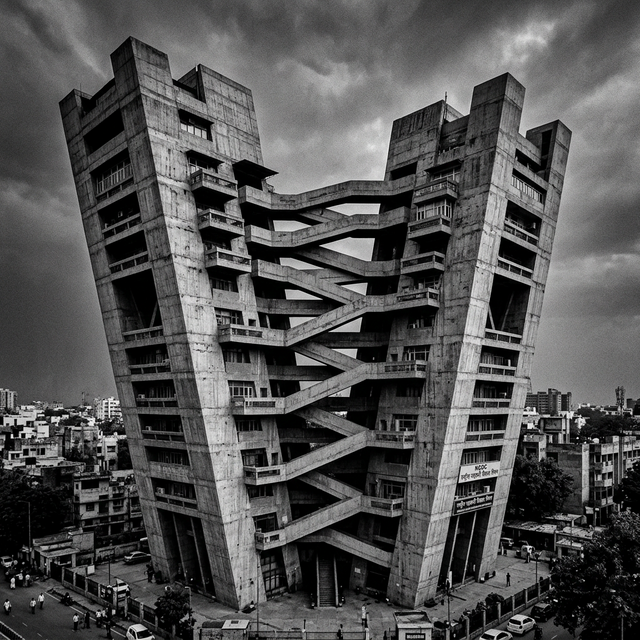
The massive, leaning twin brutalist towers connected by staggered concrete floors
1980
Kuldip Singh

NCDC Building (The 'Pyjama' Building)

New Delhi, India

An idiosyncratic, breathtaking zenith of Indian structural Brutalism, designed by Kuldip Singh. The headquarters of the National Cooperative Development Corporation (NCDC)—affectionately nicknamed the 'Pyjama Building' due to its peculiar, twin-legged silhouette—represents an absolute, unyielding engineering feat. Unlike traditional vertical towers or horizontal functionalist slabs, the NCDC Building is characterized by two massive, distinctively outward-leaning raw concrete structural cores. These colossal pylons contain the vertical circulation (elevators and stairs) and the essential services. In a terrifying display of structural tension, the entire stack of eight office floors is violently suspended—staggered and zig-zagging—between these two leaning cores, completely devoid of centralized load-bearing columns. The resulting aesthetic is aggressively massive; a monumental, concrete arch imposing its incredibly distinct, muscular profile against the Delhi skyline. Like many structures of the era, the building wears its construction history proudly; the entirety of the exterior was left in exposed concrete. More remarkably, Singh engineered this incredibly tense, monumental structural system entirely on traditional drafting boards without the aid of modern computerized structural modeling software. It stands as an emphatic, muscular statement of Indian public sector power and sheer engineering bravado during the peak of the state-sponsored architectural expansion.

Bihar: From Colonial Mass to Concrete Spatiality

The architectural lineage of Bihar, particularly its capital Patna, offers a microscopic view into the subcontinent's stark transition. The timeline moves from the unyielding, impenetrable mass of colonial-era structures to hyper-modern spatial configurations, while retaining a raw material honesty that echoes the core Brutalist ethos of explicit tectonic legibility.

// THE BASELINE

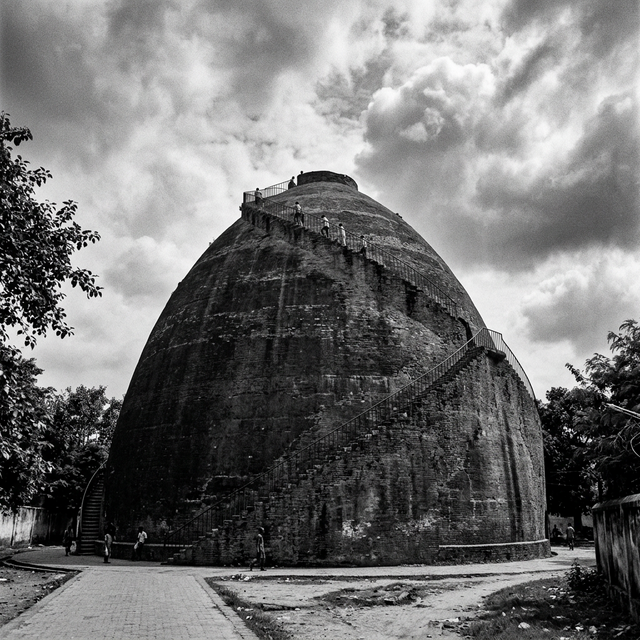
The Golghar

1786
The colossal brick stupa-like granary, a sheer, unadorned structural mass

Constructed by the East India Company strictly as an immense granary following devastating famines, the Golghar is a brutal lesson in singular, unadorned functionalist mass. Its continuous, stupa-like brick curve strictly lacks any ornamentation, dictating its imposing, terrifying form entirely through extreme utilitarian volumetric necessity. It serves as an early, proto-brutalist example of architecture entirely stripped of deceit.

// MODERN INTERVENTION

2015

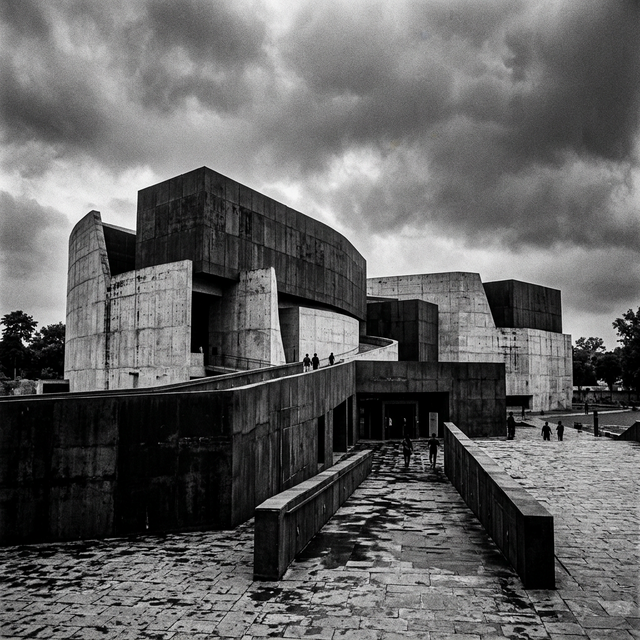
Bihar Museum

ARCHITECT: Maki and Associates & Opolis
Weathering steel and concrete volumes defining modern architectural mass

A sprawling campus that fundamentally reinterprets monumental scale through modern, decentralized spatial dynamics. It heavily relies on weathering Corten steel and raw, extremely heavy concrete forms that coalesce into sharp, asymmetrical geometric volumes. Rather than presenting a single, imposing facade (as a traditional colonial museum would), it shatters the static singularity of older civic buildings, creating a fluid, yet undeniably heavy material experience.

Patna, Bihar

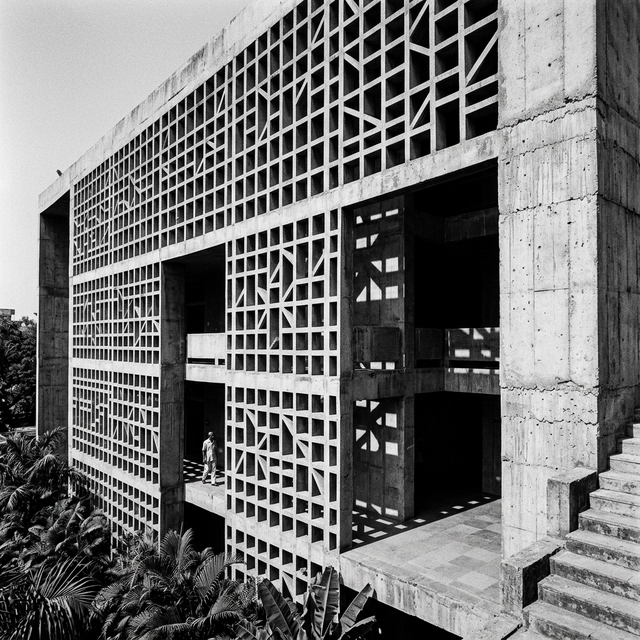
The Veiled Building

ARCHITECT: KUN Studio
A severe concrete facade utilized to mitigate aggressive heat

A contemporary, hyper-local exploration of severe, heavy concrete screening. It inherits the traditional Indian 'jaali' (screen) but explicitly takes the Brutalist obsession with 'truth to materials' and applies it aggressively to environmental mitigation. It uses harsh, perforated, unyielding concrete shells to severely filter brutal heat while presenting an impenetrable, almost hostile facade to the chaotic street—a modern continuation of the Brutalist impulse to fortify against an unforgiving exterior.