GLOBAL
MONOLITHS
Unité d'Habitation
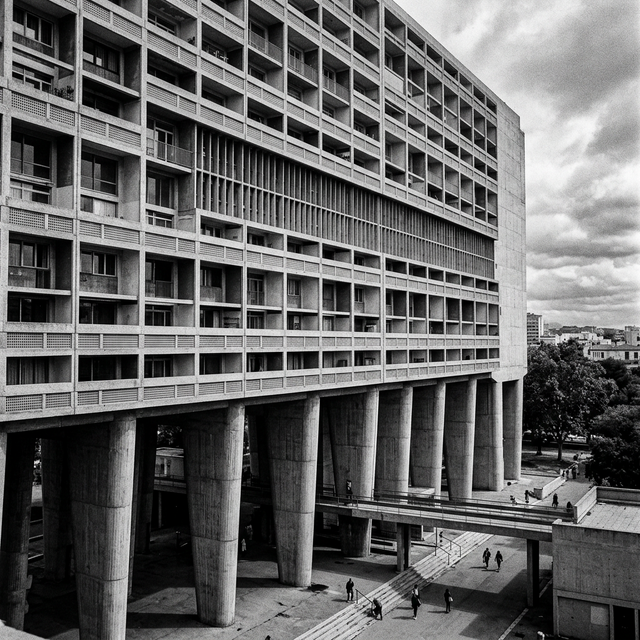
Universally recognized as the genesis of the Brutalist movement. Designed by Le Corbusier as a radical solution to the severe post-war housing shortages in France. The Unité d'Habitation is a colossal, self-contained vertical garden city—a singular architectural monolith designed to house roughly 1,600 people while providing an internal commercial street spanning halfway up the structure. It was the first major architectural application of 'béton brut' (raw concrete). Driven by crippling national shortages of structural steel and polished facing materials, Corbusier chose to physically embed the violent, manual labor of the construction process directly into the building's massive aesthetic. By intentionally leaving the rough, knotty grain of the wooden shuttering boards deeply imprinted onto the finished concrete surface, the structure achieved an archaic, earthy honesty that was a stark rejection of pre-war modernist 'white box' purity. Structurally, the entire 337-apartment block is hoisted dramatically above the ground plane upon massive, sculpturally muscular pilotis (stilts). This deliberate elevation allowed for uninterrupted pedestrian circulation beneath the immense weight of the building. The facade is defined by its deep, grid-like cellular composition of loggias, forming massive brise-soleils (sun-breakers) that shield the deeply recessed glass walls from the harsh Mediterranean sun. Furthermore, Corbusier completely dictated the spatial organization of the Unité using his proprietary Modulor proportioning system—an anthropometric scale based on human dimensions—ensuring that despite its monumental, almost terrifying scale, the interior volumes maintained a profound geometric harmony with the human body.
Boston City Hall
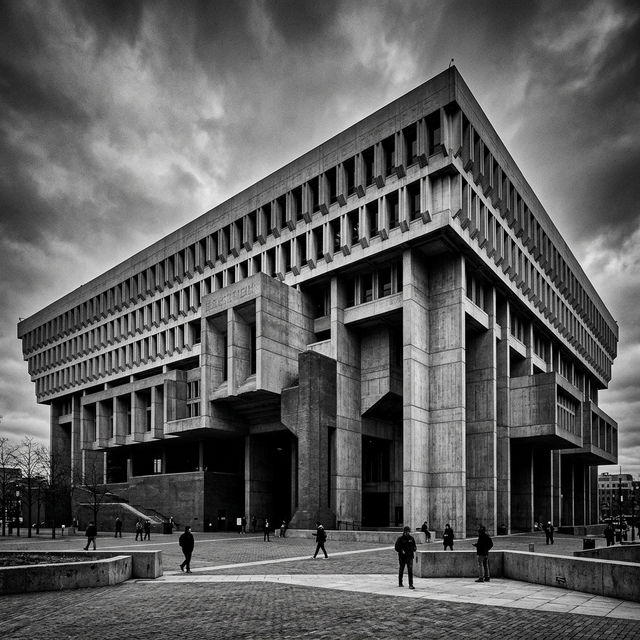
A polarizing masterpiece of programmatic articulation. Kallmann McKinnell & Knowles won the international competition to design a new centerpiece for Boston's sweeping 'Government Center' urban renewal project. The resulting structure is an incredibly muscular, unapologetic assertion of civic authority. Boston City Hall is a defining example of how Brutalism sought to physically express internal function on the exterior facade. The building acts as an inverted ziggurat; it begins relatively slender at its massive brick plaza base (intended to seamlessly pull public assembly space into the cavernous lower atriums) and then violently cantilevers outward as it rises. The architectural legibility is stark: the deeply recessed, dark lower levels house open-access public service counters; the chaotic, drastically protruding monumental forms in the mid-section unequivocally house the offices of democratically elected officials (the Mayor's office and City Council chambers project decisively outward, hovering over the plaza like commanding ceremonial balconies); and the repetitive, densely gridded upper stories contain the immense bureaucracy of municipal administration. The structure relies heavily on aggressively expressed, precast concrete fins and incredibly deep concrete hoods that bracket massive expanses of glass. These hoods act simultaneously as structural bracing, sun-shading, and overwhelming visual indicators of the building's unyielding, monumental mass. The material palette was deliberately severe: board-marked cast-in-place concrete for the massive supporting columns, precast concrete for the sweeping cornices, and Welsh quarry tile mirroring the vast brick plaza on the interior public levels. It stands as an architectural manifestation of a tough, modern governance replacing a corrupt, hidden past.
Trellick Tower
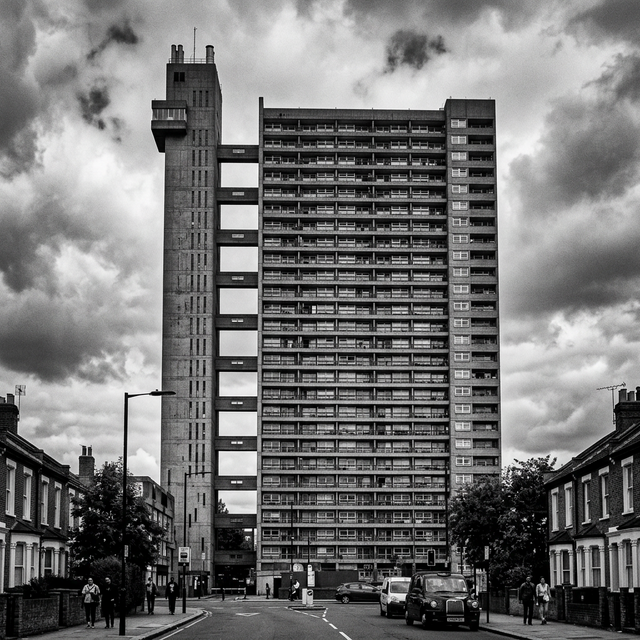
The terrifyingly elegant pinnacle of British high-rise social brutalism. Erno Goldfinger's masterpiece dominates the West London skyline with its aggressive, unyielding, and totally exposed structural profile. Rising 31 stories, Trellick Tower's defining architectural feature is its stark, almost clinical separation of function. Goldfinger radically detached all the utilitarian machinery of the building into a distinctly slender, totally free-standing service tower containing the elevators, the emergency egress stairs, the trash chutes, and heavily fortified boiler rooms situated violently at the tower's absolute peak within an aggressively cantilevered plant room. This isolated service shaft is then surgically connected to the massive, sprawling residential slab strictly via semi-exposed concrete walkway bridges that cross the catastrophic spatial gap at every third floor. This ingenious (if imposing) configuration accomplished two crucial sociological goals: it freed the main residential block to enjoy totally unencumbered floor plans stretching the entire east-west width of the building, granting every apartment cross-ventilation, immense natural light, and massive, deeply recessed brutalist balconies. Secondly, by isolating the notoriously noisy elevators and garbage chutes, he dramatically minimized acoustic disturbances for the residents. The facade itself is a severe essay in extreme grid repetition, broken only by the structural necessity of the access galley levels. The raw concrete finishes, combined with the unapologetic, muscular massing, eventually subjected Trellick to universal vilification in the 1980s as the 'Tower of Terror' due to intense social neglect—a reputation it aggressively shed in the 21st century as it became a highly sought-after symbol of architectural heroic purity.
Barbican Estate
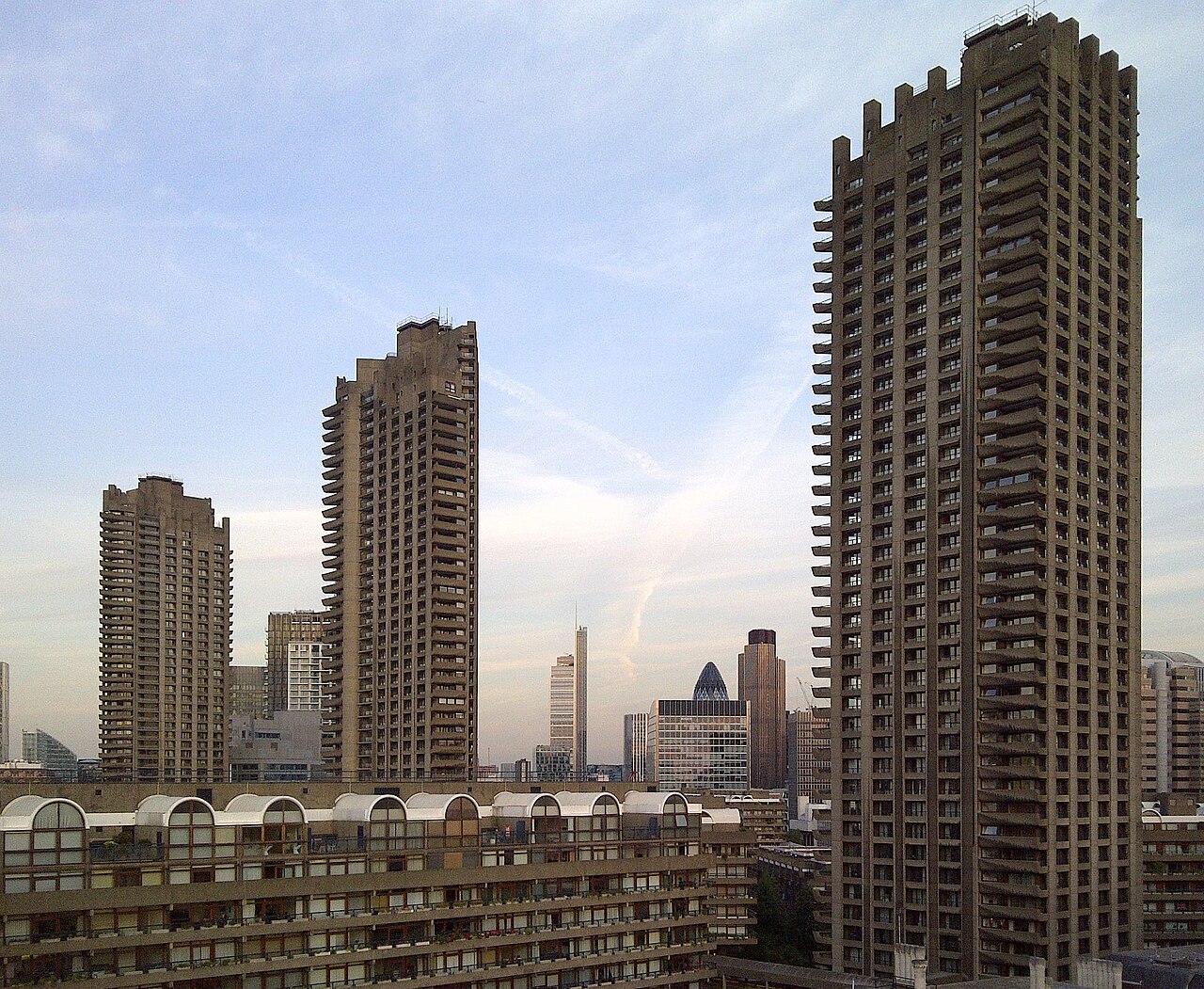
An unprecedented, sprawling urban megastructure constructed to resurrect a massive forty-acre precinct of the City of London utterly obliterated during the WWII Blitz. Rather than rebuilding traditional street networks, Chamberlin, Powell and Bon proposed a radical, multi-level utopian fortress—one of the largest inner-city brutalist developments ever realized in Europe. The Barbican is famously characterized by its severe geometric separation of pedestrian and vehicular traffic. Cars, service deliveries, and subway lines are completely buried in a vast subterranean labyrinth of parking garages and tunnels. Pedestrians, conversely, exist entirely upon immense elevated 'highwalks'—massive, sweeping concrete podiums suspended stories above the ground, totally divorcing human interaction from the chaos of the traditional street level. These podiums snake around massive structural forms: endless, curving residential terrace blocks (some seven stories high) wrapped in deep, rhythmic semi-circular balconies; artificial sunken lakes punctuated by brutalist fountains; sprawling conservatory gardens; an enormous sunken arts center; and three monolithic, 40-story triangular residential towers (Cromwell, Shakespeare, and Lauderdale) featuring spectacularly aggressive, saw-toothed structural profiles designed to mitigate downdrafts. The Barbican's signature technological achievement lies in its finish. Having witnessed the brutal weathering of earlier raw-cast structures, the architects insisted on extensive, incredibly labor-intensive bush-hammered concrete. Armies of laborers utilized pneumatic drills to physically shatter the smooth outer veneer of the cured concrete, exposing the dark, crystalline aggregate beneath. This created a rough, highly textured, deeply porous surface that aged magnificently, actively hiding water stains and preventing the tragic aesthetic spalling that ruined so many of the Barbican's contemporaries.
Teresa Carreño Cultural Complex
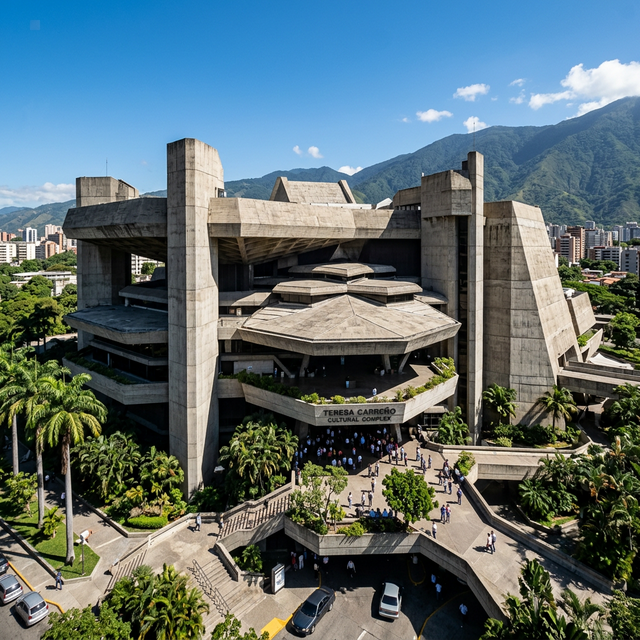
A titan of Latin American Brutalism. The Teresa Carreño Cultural Complex is a staggering achievement in concrete, designed to function as a multidisciplinary cultural center of unprecedented scale. Constructed between 1973 and 1983, the complex is defined by its massive, sculptural use of 'béton brut' and its unique, almost overlapping hexagonal roof systems that soar over a vast public atrium. The architects—Lugo Marcano, Sandoval, and Kunckel—conceived the structure as a hybrid between a medieval fortress and a futuristic space station, emphasizing raw material honesty and structural transparency. The interior houses the Ríos Reyna and José Félix Ribas halls, world-class performance spaces integrated into the concrete monolith with obsessive attention to acoustics and theatrical mechanics. The complex spans over 22,000 square meters, utilizing enormous columns to lift its weight and create a seamless connection between the urban fabric of Caracas and the lush mountain backdrop. It remains a definitive statement on the ability of Brutalism to harmonize monumental scale with cultural intimacy.